

Benang Kelambu and Benang Stokel are two separate waterfalls in Central Lombok, a short walk apart from the same entrance near Aik Berik. Stokel is the easy, flat walk with a swimmable pool. Kelambu is the uphill one with the wide, curtain-like flow that photographs better. Most day trips visit both, but if you truly only have time for one, the right pick depends on who you're traveling with.
Tour drivers get asked the same question at the parking lot almost every time: "wait, are we visiting one waterfall or two?" The confusion is fair, since Benang Kelambu and Benang Stokel share a ticket booth, a parking area, and a name that sounds like it should belong to one place.
They are two different waterfalls with two different personalities, and if your schedule only allows one of them, the pick should depend on your knees, your camera, and who's standing next to you in the group photo.
What Actually Separates Benang Kelambu From Benang Stokel
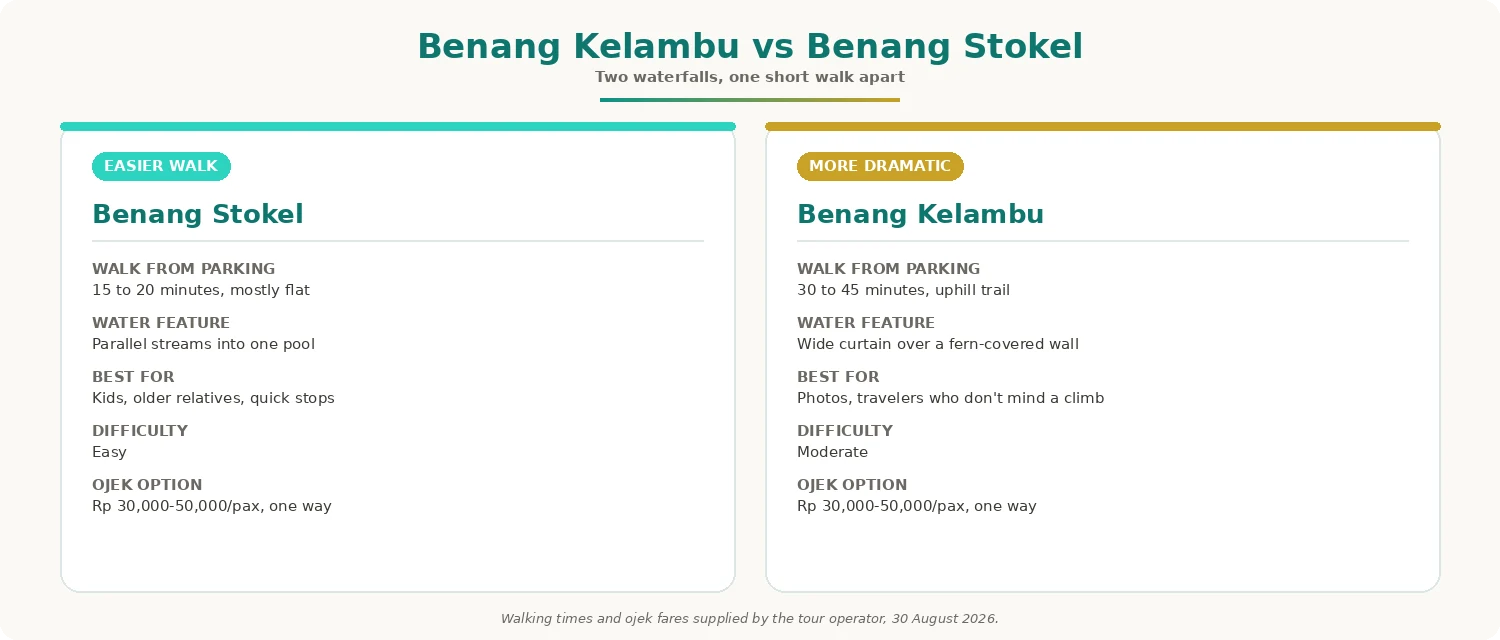
Start with the name, because it explains the whole comparison. "Kelambu" means mosquito net, or curtain, and it earns the name: water fans out across a wide, fern-draped rock face like a curtain, rather than falling in one column. Benang Stokel does the opposite, narrowing several smaller streams into one calm pool at the bottom, which is exactly why it's the one people actually swim in.
Choosing by what looks good on your feed, Kelambu wins easily. Choosing by where your seven-year-old can safely get in the water, Stokel wins just as clearly. Neither is the "lesser" waterfall; they're built for different afternoons, the same way Lombok Tour Packages by Lombok Travelution get built around the traveler.
The Walk: Which One Costs You More Effort
This is where the decision usually gets made, whether people realize it or not. Benang Stokel sits close to the entrance on a mostly flat path, about 15 to 20 minutes on foot. Benang Kelambu is further in, along a trail that climbs steadily for about 30 to 45 minutes on foot, and turns genuinely slippery after rain.
| Factor | Benang Stokel | Benang Kelambu |
|---|---|---|
| Walk from parking | 15 to 20 minutes, flat | 30 to 45 minutes, uphill |
| Footing | Paved, easy in any footwear | Dirt trail, slippery when wet |
| Can you swim there | Yes, a calm pool | Mostly a viewpoint, current is stronger |
| Reasonable for | Young kids, older relatives, flip-flops | Anyone comfortable on an uneven trail |
| Ojek from parking | Rp 30,000 to 50,000/pax, one way | Rp 30,000 to 50,000/pax, one way |
Those walking times come from the trail the operator's own guides actually walk, not a stopwatch estimate, and they hold regardless of season. If anyone in your group has knee trouble or is traveling with a stroller, that table alone probably just answered your question. If nobody in the group wants to walk at all, ojek riders wait at the parking area and will run you up to either waterfall for around Rp 30,000 to Rp 50,000 per person, one way, which is worth knowing before you commit to the climb on foot.
A stop like this fits neatly into a longer what you get in Lombok one day tour without eating your entire schedule, worth knowing if you're fitting in more than waterfalls today.
Which One Wins for Photos
Benang Kelambu is the one that ends up on postcards, and it earns the spot honestly: the curtain effect keeps the whole rock face doing something interesting at once, far more forgiving for photos than a single narrow stream. Morning light through the canopy adds a soft green cast most visitors don't expect and end up liking more than the water itself.
Benang Stokel photographs well too, just differently: it's the shot of people actually having fun in the water, not the dramatic wide landscape shot. Chasing one striking photo, Kelambu is worth the climb. Chasing a photo of your kids laughing in a waterfall, Stokel gets you there faster and drier.
If You Can Only Pick One
Pick Kelambu if a good photo matters more than a swim and you don't mind muddy shoes. Pick Stokel if you're traveling with young children, older relatives, or anyone who'd rather not gamble on wet rocks. If neither answer satisfies you, stop trying to pick: the One Day Tour Benang Kelambu & Benang Stokel Waterfall package covers both in one unhurried morning.
📖 Related Articles:
Not the Only Waterfalls in Lombok, Just the Closest Pair
Worth saying plainly: these two aren't the only waterfalls on the island, just the pair sharing one entrance, which is why people compare them to each other and nothing else. Closer to the north coast, see what One Day Tour Tiu Kelep Waterfall includes before committing to a direction, since driving to the wrong side of the island eats more of your day than the waterfall itself.
Nearby Tete Batu, in the same Rinjani-foothill belt, is worth folding into the same half-day. The One Day Trip Tetebatu Rice Terrace & Waterfall Lombok covers rice terraces, a slower village pace, and its own smaller waterfall close by, a reasonable add-on rather than a competing decision.
When to Go for the Fullest Flow
Both run year-round, but the season changes what you'll see. Roughly November through March, the wetter months, both run fuller and more dramatic, which suits Kelambu's curtain especially well. In the drier months the flow thins at both sites, but the Kelambu trail also dries out and stops being slippery, a fair trade for a lot of visitors. Neither season is "wrong," they're just different waterfalls depending on when you show up.
One more honest note while you're planning: Lombok Travelution is a licensed member of AITTA and ASTINDO, Indonesia's tourism trade associations, which mostly matters if you're the type of traveler who checks who's actually driving you before you get in the car.
📖 Related Articles:
Conclusion
The parking lot question isn't really "which waterfall is better," it's "which one matches the day you're actually having." Bring kids or a bad knee, Stokel wins without a fight. Bring a camera and a bit of patience for mud, Kelambu earns the climb. Bring enough time for both, and the whole debate quietly disappears.
Questions People Actually Ask
Are Benang Kelambu and Benang Stokel the same waterfall?
No, they are two separate waterfalls that happen to share one entrance and parking area near Aik Berik in Central Lombok. Stokel is the easier, flatter one; Kelambu sits further along an uphill trail.
Which waterfall is better for young kids or older relatives?
Benang Stokel. The walk is short and flat, and the pool at the bottom is calm enough to actually swim in, unlike Kelambu's stronger current.
Can I visit both in one trip?
Yes, and most visitors do exactly that, since they share the same entrance. A relaxed visit to both usually fits into a single morning.
Which waterfall is better for photos?
Benang Kelambu, generally. Its wide, curtain-like flow across a fern-covered rock face gives a more dramatic wide shot than Stokel's narrower pool.
Is the walk to Benang Kelambu difficult?
Moderate, not extreme. Expect about 30 to 45 minutes of steady uphill walking on a dirt trail that gets slippery after rain, so proper footwear matters more here than at Stokel. If you'd rather skip the climb, ojek riders at the parking area will take you up for about Rp 30,000 to Rp 50,000 per person, one way.
What is the best time of year to visit?
Roughly November through March brings fuller, more dramatic flow at both waterfalls. The drier months thin the flow but keep the Kelambu trail less slippery, which some visitors prefer.
Do I need a guide to visit?
It isn't strictly required for Stokel, but it helps at Kelambu, where the trail forks and can be confusing after rain. A private tour also saves you from arranging transport to a fairly rural entrance on your own.
About the Author