

Quick summary: Gili Sudak sits in the Sekotong cluster off south-western Lombok, not in the Gili Trawangan cluster up north. Its best reef patches are shallow and close to shore, which makes them beginner-friendly. Boats are chartered from small harbours in Sekotong and priced per boat, not per head. The water is clearest in the early morning, before boat traffic lifts sediment off the bottom. Any cost figure in this article is an estimated range, not an official rate.
There are two kinds of travellers looking for a Gili in Lombok. The first wants music, a beach cafe, and a rented bicycle. The second wants to stand in waist-deep water counting fish. Gili Sudak belongs firmly to the second group, which is exactly why people keep arriving at the wrong island.
Gili Sudak Is Gili Trawangan's Quiet Cousin
On a map, Gili Sudak sits in the waters of Sekotong, in the south-western corner of West Lombok, in the same cluster as Gili Nanggu and Gili Kedis. Gili Trawangan and its two neighbours are on the opposite side, up north, which is worth knowing before you book anything. Getting from Lombok International Airport to the Sekotong crossing point usually takes around 1.5 to 2 hours by road. So if anyone suggests squeezing Gili Sudak in on the same day you come down from Sembalun, decline politely. Technically possible. In good conscience, not recommended. For a sense of how a northern cluster day compares,One Day Tour Gili Trawangan, Gili Air & Gili Meno covers the other side.
The island itself is small enough to circle on foot in under half an hour. No nightlife, no row of shops, and mobile signal that works only when it feels like it. For some people that is a shortcoming. For anyone coming to snorkel, it is the whole point: less activity on land means less sediment reaching the water.
The Reef Patches Actually Worth Getting Into
Gili Sudak's real strength is its friendly depth. On the eastern side, not far from where the boats pull in, a sandy bottom slopes gently into reef sitting roughly one to three metres deep. You can watch clownfish, butterflyfish, and clouds of small blue fish without diving at all. That matters: most snorkelling mishaps happen because someone pushed into water deeper than their ability, not because of current.
The second spot is the sandbar between Gili Sudak and Gili Kedis. At low tide it surfaces as a walkable tongue of sand, and its edge marks the boundary between bright sand and reef. That colour contrast is what makes visibility feel higher than it is. If you would rather have both spots arranged for you, boat and water guide included, the One Day Secret Gili Tour treats them as one planned trip rather than something you negotiate on the jetty.
About the Boats: The Price Is Not on a Board Anywhere
This is the part that catches most people off guard, and we would rather be honest than hand you a number that expires tomorrow. Boat charter in Sekotong is priced per boat, not per person. One wooden boat typically carries around 8 to 12 people, so arriving as a couple feels expensive and arriving as a group of six feels cheap, even though the boat costs the same. Three other line items belong in your budget: the area retribution fee, gear rental, and a water guide if anyone cannot swim.
As a rough guide, chartering one boat for the three-island route usually falls in the hundreds of thousands of rupiah for half a day. That is an estimated range, not an official rate, and it shifts with the season and fuel prices. If you would rather have every line item locked in before you fly, see what Lombok one day tour includes.
📖 Related Articles:
When Is the Water Clearest? Not at High Noon
Plenty of people set off at ten because it feels like a civilised hour to start a holiday. Unfortunately, it is also the hour when every boat leaves at once. Propellers and anchors lift fine sand off a shallow bottom, and that sand takes time to settle. Mornings win not because of the light, but because the water has not been stirred yet.
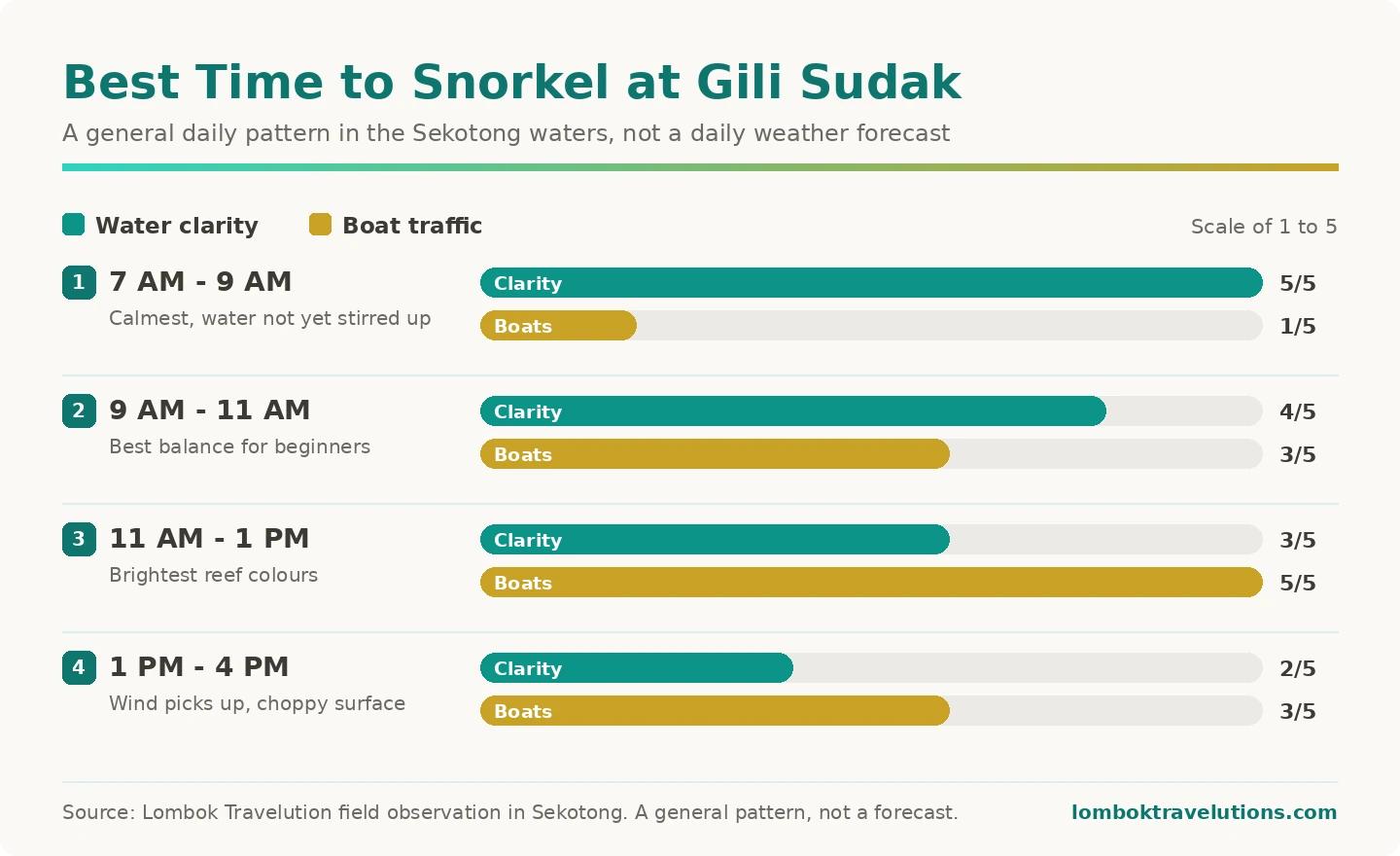
Closer to midday the sun sits directly overhead and reef colours look their brightest. The problem is that the crowd peaks at the same hour. After about one in the afternoon the sea breeze picks up and the surface turns choppy, so your mask floods more often. Not dangerous, just tiring.
Fitting Three Gilis into One Day Without Wearing Yourself Out
Gili Sudak is rarely visited on its own, and it does not need to be. Each island in this cluster has a distinct character, so combining them is more than adding stops.
| Island | Atmosphere | What stands out | Best suited to |
|---|---|---|---|
| Gili Nanggu | Most organised | Long beach, the most complete facilities on land | Families with small children |
| Gili Sudak | Quietest | Shallow reef close to shore, easy to reach | Beginners and long stretches in the water |
| Gili Kedis | Smallest | A tiny islet you can circle in a few minutes | Photos and a short stop |
The sensible order is to snorkel first and save the islands that ask for time on land until later. The reasoning is simple: clear water has an expiry hour, white sand does not. For a pink-sand beach in the same southern sweep, pink beach lombok covers that coast on a comparable half-day rhythm.
If you have one extra day, do not spend it adding another island. Spend it changing the scenery. Coming out of the sea and up into the cool air at the foot of Rinjani is a contrast you will remember far longer than a fourth gili, which is how what you get in Lombok 4D3N Tour Package is arranged.
Small Things That Quietly Ruin a Good Plan
What usually goes wrong is never dramatic. First, not carrying cash: small warungs on the island do not always have card readers, and the signal for a transfer is not something to rely on. Second, wearing thin flip-flops and crossing rocky ground anyway. Third, standing on the reef to catch your breath. One footstep can snap growth that took years to build, which destroys the very reason you came. Fourth, chartering a boat without agreeing the hours, then being asked to head back exactly when you are enjoying it most.
📖 Related Articles:
Conclusion
Gili Sudak does not sell luxury and does not pretend to be Gili Trawangan. What it offers is simpler: shallow reef you can enjoy without special skills, water that is clearest at a predictable hour, and an island quiet enough that you hear the sea instead of engines. Come early, agree the charter hours, bring cash, and never stand on the reef. The rest, let the sea handle.
Questions People Ask Most Often
Is snorkelling at Gili Sudak safe for complete beginners?
Reasonably safe, because the main reef patches sit at roughly one to three metres and are not far from the shoreline. Beginners should still wear a flotation vest and stay with a water guide, especially anyone who cannot swim. What to avoid is drifting into deeper water simply because the rest of the group did.
Is the boat charge per person or per boat?
Per boat. One wooden boat in Sekotong generally takes around 8 to 12 people, so the cost per head drops sharply as passengers are added. That is why small groups feel it is expensive when the boat itself costs the same as it would for a large group. Agree on the charter duration up front too, not just the price.
Do I need to bring my own snorkelling gear or can I rent on site?
Rental gear is available at the crossing area and on the island, so bringing your own is not compulsory. That said, if you own a mask, bring it. A mask that seals properly is the one piece of equipment that decides how comfortable the day is, and every face is a different shape. Water shoes help on rocky ground too.
How long is ideal to spend at Gili Sudak?
About one to two hours is enough to enjoy the main reef patches and walk around the island. When Gili Sudak is combined with Gili Nanggu and Gili Kedis on a half-day route, that allocation keeps the day relaxed instead of turning it into a race between islands.
Is Gili Sudak still worth visiting during the rainy season?
It is, but adjust your expectations. Rain and wind make the surface choppy and keep sediment suspended longer, so visibility drops. Boat departures also depend more heavily on the sea conditions that day. The morning window becomes even more important, and it is worth having a land-based fallback plan ready.
Are there fresh water and changing facilities on the island?
Basic facilities exist, but do not picture resort standards. Bring your own towel, a change of clothes in a waterproof bag, and enough cash, because digital payment is not always reliable on a small island. Carrying your own rubbish bag helps as well, since waste handling on small islands is always limited.
About the Author